 Retirement Planner Guide
Guaranteed Income Supplement
The Guaranteed Income Supplement is an extra, tax-free monthly benefit for OAS recipients with a low income. Retirement Planner works it out for every year from the client’s other income — there is nothing to enter except the age it starts.
How GIS is worked out
- Income counted: the year’s taxable income from every source except OAS and GIS itself. TFSA withdrawals don’t count.
- Reduction: the maximum GIS goes down by 50 cents for each dollar of that income, until nothing is left.
- Single, widowed or divorced: the single maximum applies.
- Married or common-law: the couple’s combined income is counted against the rate for a spouse who also receives OAS. The spouse’s income comes from the linked spouse strategy; without one, it counts as zero. See Spouses and partners.
- Widowhood: after the linked spouse’s planning age, GIS switches to the single rate.
- GIS is not taxable, and the maximum amounts grow with inflation.
The marital status is set on the GIS tab of the client’s profile.
The GIS tab
Set Benefits Age to the age GIS starts — 65, or the age OAS started. Choose Annual for yearly amounts or Cumulative for running totals.
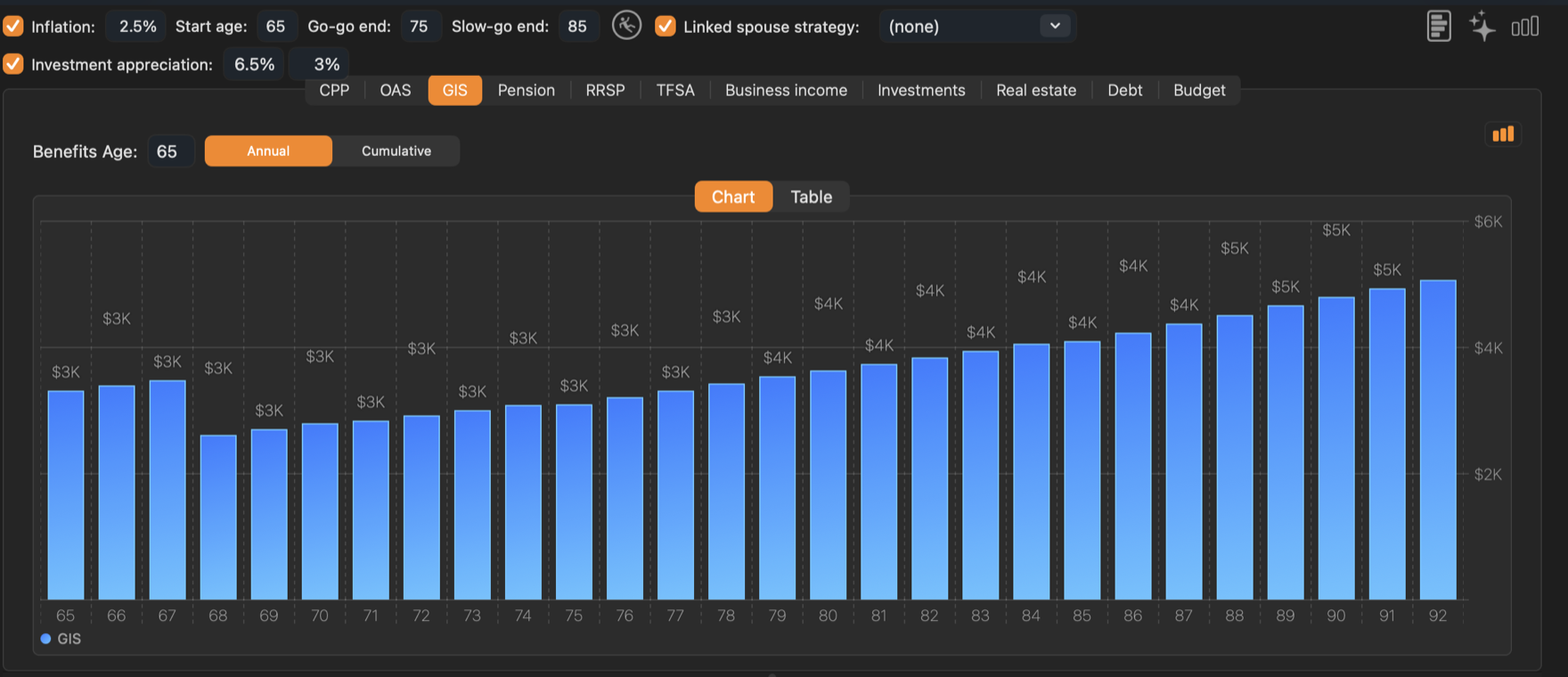
Evelyn’s GIS dips at 68, when her RRIF withdrawals begin: every RRIF dollar reduces GIS by 50 cents. It then grows again with inflation.
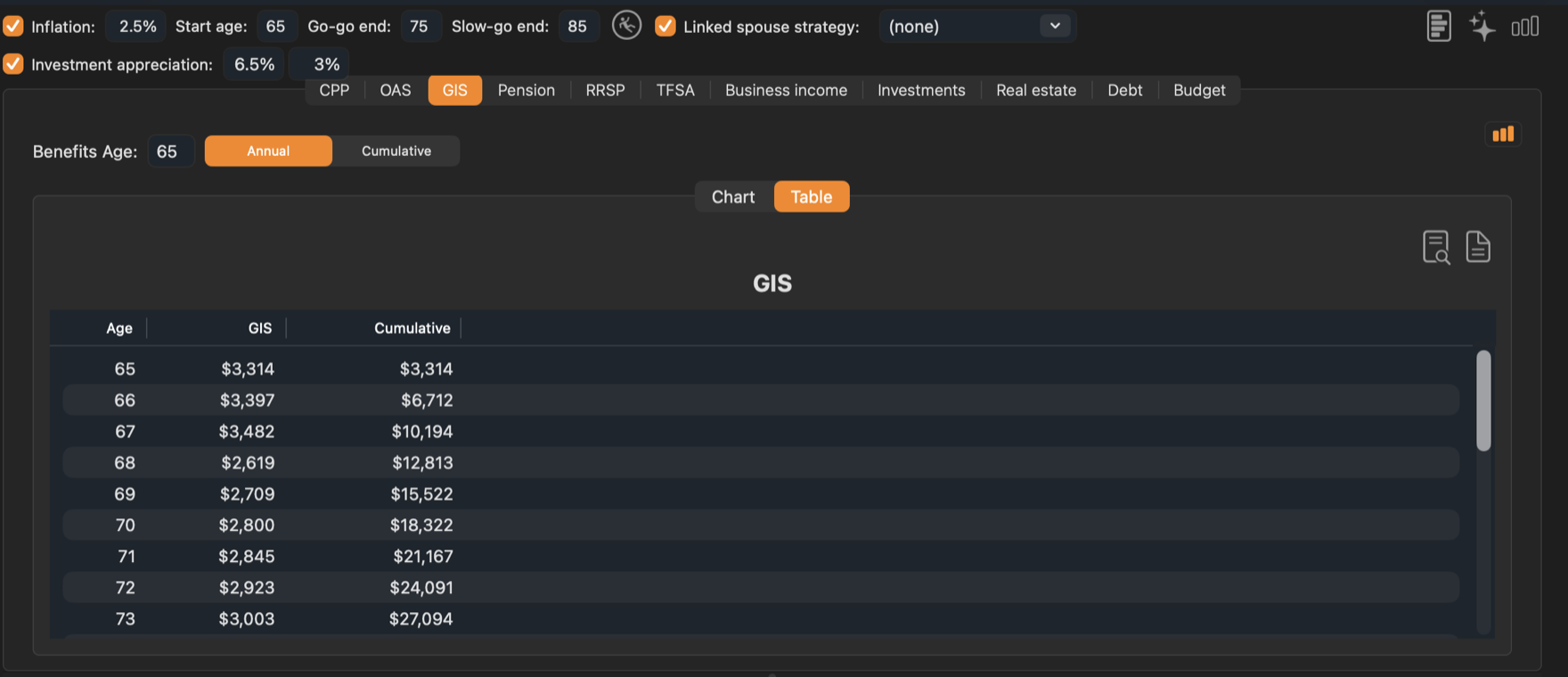
The Table tab lists Age, GIS and Cumulative.
For someone close to the GIS income limit, TFSA withdrawals are worth more than RRSP withdrawals: they don’t reduce GIS. Compare a strategy that draws from the TFSA first. See Comparing strategies.
GIS is estimated from the same year’s income. The real benefit is based on the previous year’s tax return, and some income, like the first $5,000 of employment income, is exempt.